
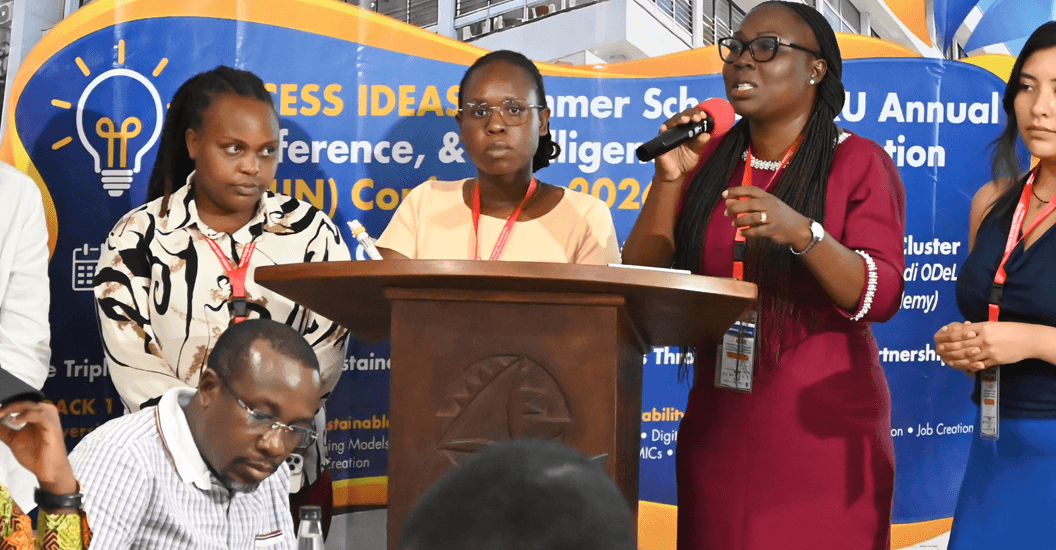
MKU Researchers Showcase Innovative Research and Sustainable Solutions at the 2026 Annual University and iN4iN Conference
Mombasa, Kenya | 12–13 November 2026
Mount Kenya University (MKU) researchers showcased innovative research, emerging technologies and practical solutions to contemporary development challenges during the 2026 Annual University and AUC-iN4iN Conference, held at PrideInn, Mombasa.
Held under the theme “Co-Creating Sustainable Solutions: Scaling MSMEs through SDG 9,” the conference provided a platform for researchers to share findings, exchange ideas and explore how universities, industry and other stakeholders can collaborate to advance innovation, entrepreneurship and sustainable development.
The poster presentations reflected MKU’s commitment to research that responds to real-world challenges, with particular attention to the role of technology, education, enterprise development and strategic partnerships in driving inclusive economic growth.
Research highlights
1. Artificial Intelligence and emerging technologies in higher education
One of the key research areas explored the opportunities and challenges associated with deploying humanoid robotics in African universities.
In a presentation titled Deploying Humanoid Robotics in African Universities: Opportunities, Challenges, and Educational Framework, Elena Mwai examined the institutional preparedness required to integrate robotics into teaching and learning.
Drawing on the case of MKU’s Robotics, AI and Immersive Technologies (RAIT) Laboratory, the study highlighted the importance of governance, safety protocols, staff capacity building, curriculum integration and institutional readiness before deploying humanoid robots in learning environments.
The proposed framework provides a phased approach to responsible adoption, including infrastructure preparation, staff certification, curriculum integration and continuous evaluation.
Another presentation by Dr. Ruthwinnie Munene examined Artificial Intelligence on Recruitment Efficiency in Recruitment Agencies in Nairobi County, Kenya. The study highlighted how AI-powered candidate screening, interview scheduling, communication chatbots and data analytics can improve recruitment processes, reduce administrative workloads and enhance the quality of recruitment services.
The findings pointed to the importance of investing in AI-powered analytics and building staff capacity to support data-driven recruitment decisions.
2. Strengthening MSME financial management and enterprise development
Research on micro, small and medium enterprises (MSMEs) featured prominently, reflecting the importance of entrepreneurship and enterprise development in achieving SDG 9.
Dr. Jared Mosoti presented research on Enhancing Financial Management Skills among MSMEs through Universal Design for Learning: Evidence from Kenya.
The study demonstrated the potential of inclusive, practical training approaches in strengthening financial management competencies among MSME owners. Post-training assessments recorded improvements across budgeting, cash-flow management, financial record-keeping, working capital management and financial decision-making.
For instance, cash-flow management scores increased from 38.6% before training to 81.2% after training, demonstrating the value of practical and inclusive learning approaches in building enterprise capacity.
Complementing this research, Joan Mumaraki presented a conceptual framework titled Bridging the Finance and Risk Gap: A Project-Based Service Learning Model Linking MKU Students with Thika MSMEs for Sustainable Livelihoods and Graduate Employability.
The proposed model seeks to connect MKU students pursuing finance, accounting and risk-management programmes with selected MSMEs in Thika. Through supervised, community-based projects, students would support businesses in improving financial records, cash-flow visibility and risk management while gaining practical experience and strengthening their employability.
The proposed 12-week pilot would create opportunities for collaboration between the University and local enterprises.
3. Sustainability and business resilience among Kenyan enterprises
Ms. Brenda Weloba and Ms. Victoria Mwendwa Njogu presented research on Influence of Integrated Sustainability Strategies on SME Performance in Kenya.
The study examined how economic, social and environmental sustainability strategies influence enterprise performance and resilience.
The findings highlighted the importance of sound financial management, digital capabilities, responsible resource utilisation, employee welfare and supportive partnerships.
The presentation also highlighted the growing adoption of digital tools among Kenyan micro and small enterprises. Digital payment acceptance increased from 59% in 2020 to 86% in 2023, while digital record-keeping increased from 39% to 54% over the same period.
The researchers recommended stronger university–enterprise partnerships through business clinics, mentorship, incubation programmes and supervised student consulting.
In a related presentation, From Collaboration to Co-Creation: A Contextual Framework for University–Industry Innovation in Kenya, Ms. Victoria Mwendwa Njogu and Ms. Brenda Weloba explored how universities and businesses can move beyond conventional partnerships towards jointly developing and implementing innovative solutions.
The conceptual framework emphasised shared problem definition, joint decision-making, resource mobilisation, trust and the development of solutions that generate measurable economic, social and environmental value.
4. Indigenous knowledge as a driver of innovation and the creative economy
Dr. Ruth Njoroge, Senior Lecturer in History at MKU’s School of Social Sciences, presented From Cultural Heritage to Creative Economy: Leveraging Samburu Indigenous Arts for Innovation, Entrepreneurship and Sustainable Development in Kenya.
The research explored the cultural significance of traditional Samburu body adornment and its potential to contribute to contemporary creative industries.
It highlighted opportunities for adapting indigenous artistic designs into fashion and textile products while preserving cultural identity and community knowledge.
The study demonstrated how indigenous knowledge can contribute to entrepreneurship, employment creation, sustainable livelihoods and culturally responsive innovation.
Expanding access to academic and research opportunities
The conference also featured Academic Radar, a platform designed to improve access to academic opportunities for students, researchers and institutions across Africa.
The platform brings together opportunities including Master’s and PhD programmes, postdoctoral fellowships, academic positions, research grants and scholarships from different sources.
Its presentation highlighted the importance of making academic opportunities more accessible while encouraging African universities and research institutions to publish their available opportunities on a shared platform.
Advancing the university–industry innovation agenda
Collectively, the poster presentations reinforced the importance of research-driven solutions in addressing challenges affecting education, business, employment and sustainable development.
They also demonstrated the value of connecting academic research with practical applications, particularly through university–industry collaboration, student engagement and interdisciplinary innovation.
The presentations aligned with Sustainable Development Goal 9 (SDG 9): Industry, Innovation and Infrastructure, highlighting the role of universities as important drivers of knowledge creation, technological advancement, entrepreneurship and sustainable economic transformation.
Through initiatives such as the ACCESS collaboration and the AUC-iN4iN Conference, Mount Kenya University continues to provide platforms for researchers, industry practitioners, students and international partners to exchange knowledge, develop ideas and explore solutions to shared development challenges.
The conference reaffirmed that sustainable innovation requires more than ideas; it calls for collaboration, practical research and partnerships that translate knowledge into meaningful impact.


