
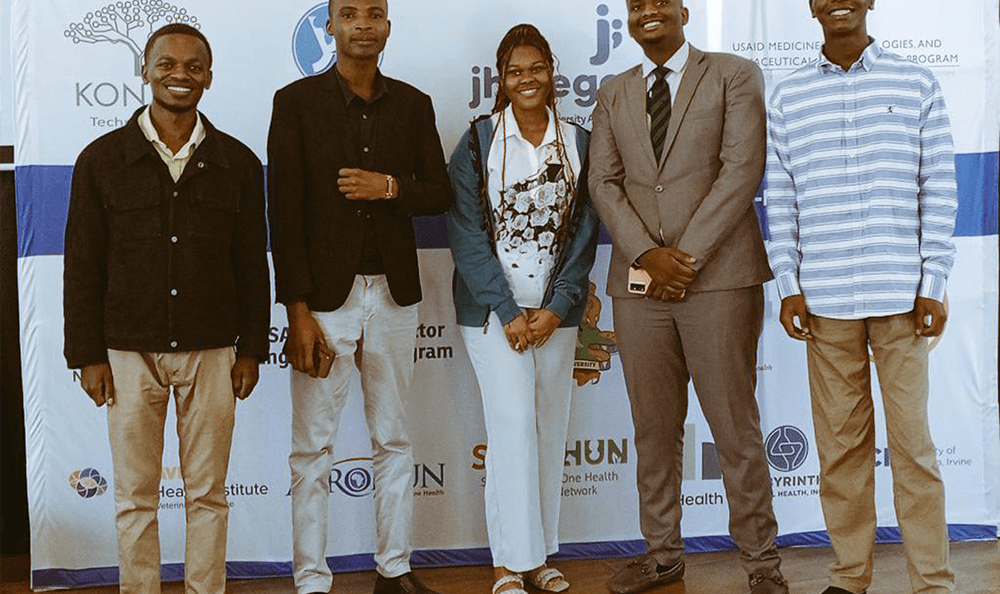
Four (4) Mount Kenya University students at the innovation hub began with a simple question: what if the black smoke choking our cities was not the end of the problem, but the beginning of a solution?
Next month, that question is taking them to the United States. Wesley Njenga, Franklin Mwendwa, Elijah Maina and Ejike Chinyere from the School of Public Health have been selected as finalists in the prestigious Wege Prize, organised by Ferris State University.
The team will travel to Michigan to present their innovation, Ecoscrubber a hybrid emission control and carbon-capture system designed to remove toxic pollutants and greenhouse gases from incinerators while converting the captured residues into useful construction materials.
The annual Wege Prize brings together some of the world’s brightest student innovators from five continents, all working to address environmental challenges through circular economy solutions. This year, five finalist teams will compete at the live finals on May 15 for a share of the $65,000 prize pool.
According to the Innovators, the idea behind Ecoscrubber was sparked by a real-life encounter.
While walking along a road in Thika, the students noticed a truck emitting thick black smoke. As people struggled to breathe and hurried past, the moment raised a defining question: what if those emissions could be captured and turned into something valuable?
Back at the university’s Innovation Hub, the team began developing their concept. Instead of allowing harmful emissions to disperse into the atmosphere, Ecoscrubber captures pollutants directly from incinerator chimneys and processes them into products such as bricks and construction blocks effectively turning waste into wealth.
The journey, however, was far from smooth.
Early prototypes struggled to capture emissions effectively, forcing the team to revisit their approach. Through long hours of experimentation, refinement of chemical processes, and continuous iteration, they eventually developed a working solution.
Their progress was supported by the Innovation and Incubation Centre and faculty mentors from the School of Public Health.
“We are proud of their progress. The university provided technical support, exposure during the annual Research and Innovation Week, and guidance that helped shape the idea into a viable innovation,” said mentors Ms Vivian Mmbone and Donatus Njoroge.
This milestone also reflects Mount Kenya University’s growing strength in nurturing student-led innovations through structured mentorship, access to prototyping facilities, and platforms that connect ideas to real-world application and global opportunities.
We are honoured to represent Mount Kenya University and Kenya on the global stage. Ecoscrubber is not just our project, it demonstrates that African students can develop solutions that compete with the best in the world,” said Wesley Njenga, the team lead.


